




Residential foundation waterproofing on the Rive-Sud: elastomer membrane or sprayed polyurea. A technician at your home within 48 hours. We treat the cause, not the symptom. Free quote.
Excavation
French drain
Crack repair
Excavation
French drain
Crack repair
You’ve seen a crack on the foundation wall. Or water seeping in after heavy rain. Your kids play downstairs, you’re renovating soon, and you want to know exactly what you’re getting into before going further.
Foundation waterproofing is what keeps water from finding its way inside and cuts off the dampness. We pinpoint the source, work from the outside, and seal it properly. Once. Not a temporary patch — a solution that lasts.
We inspect, we diagnose, we act. Every week you wait is water working against you. We stop that now.
This is the traditional method, used in the industry for years. The elastomer membrane is applied to the foundation, then covered with a Delta MS drainage panel that protects the membrane during backfilling and helps water flow toward the drain.
It’s a reliable, affordable and well-understood solution. It suits most common residential situations.
What you should know: it depends on careful application. A poorly prepared surface or a badly installed membrane can compromise the seal over the long term. It’s still a good option, but it has its limits in more demanding conditions.
Polyurea is sprayed directly onto the foundation, creating a continuous barrier with no seams, no fasteners, no weak point. It bonds to every surface — poured concrete, concrete block or rubble stone — and cures in seconds.
What sets it apart: it stays rigid against ground movement, withstands deep cold and Quebec’s freeze-thaw cycles, and structurally reinforces the foundation on top of waterproofing it. Its lifespan exceeds 50 years.
It’s the option we recommend when you want to settle this once and for all, without coming back to it.
I have marks on my foundation walls.
A white mark, a damp stain, a musty smell that keeps coming back. It’s not harmless. These are the first signs that infiltration is under way, often for longer than you think.
My basement is damp, but nothing’s leaking.
A basement that “sweats” without water actually running in is a foundation that has been working against water for a while. Over the years the concrete deteriorates, and the longer you wait, the more the damage adds up.
I want to renovate my basement
Investing in a finished basement without checking the condition of the foundation is a gamble. A waterproof membrane installed now is what protects your investment.
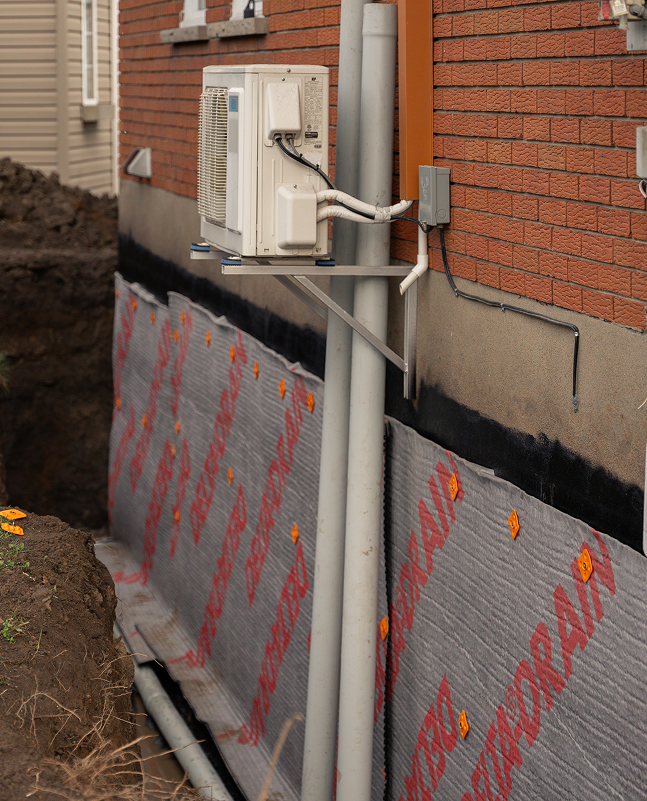
A waterproofed foundation means a home that stands up to freeze-thaw cycles, groundwater pressure, and the years.
No infiltrating dampness, no mould, no stale air. A watertight foundation means a healthy environment for the whole family.
A well-installed membrane means a sale that negotiates upward, not a condition that sinks the offer.
Every year you wait, the damage advances. Waterproofing now means avoiding a major renovation in three years.
The foundation is the one part of your home that doesn’t forgive waiting. Here’s why acting fast is the most cost-effective investment you’ll make this year.
From the outside. It’s the only way to treat the cause rather than the symptom: we locate the source of the infiltration, excavate along the foundation and apply the membrane directly on the wall before backfilling. A solution applied from the inside only manages the water once it has already come in.
Yes, always. Cracks are repaired and sealed before the membrane is installed, and this is included in the waterproofing work. Installing a membrane over an untreated crack leaves a weak point in a system that is supposed to be watertight.
It depends on the method and the conditions. Spray-applied polyurea membrane dries in a matter of seconds and withstands extreme cold: it is better suited to Quebec winters than the traditional elastomeric membrane, which is more sensitive to temperature and humidity at the time of application. A technician comes to your home within 48 hours to assess whether your work can be done now.
It depends on the product. An elastomeric membrane covered with a Delta MS panel is a proven, reliable solution for most residential situations. Spray-applied polyurea membrane forms a continuous barrier with no joints or weak points, withstands freeze-thaw cycles and lasts more than 50 years. It’s the recommended option to solve the problem once and for all.
The elastomeric membrane with a Delta MS panel is the traditional method. It is applied to the foundation, then covered with a drainage panel that protects it during backfilling and directs water toward the drain. It’s a reliable and affordable solution, but it is sensitive to the quality of the application: a poorly prepared surface can compromise long-term watertightness.
Polyurea is sprayed directly onto the foundation. It forms a continuous barrier with no joints or fasteners, bonds to poured concrete, concrete blocks and rubble stone, and dries in seconds. It stays rigid against ground movement, withstands freeze-thaw cycles and strengthens the foundation in addition to waterproofing it. It’s the option we recommend to solve the problem once and for all.
The price varies depending on the wall area to be treated, the excavation depth, accessibility around the house, the crack repairs needed and the choice of membrane (elastomeric with Delta MS or spray-applied polyurea).
We start with an assessment at your home within 48 hours, and then you receive a free, detailed quote. The price you see is the price you pay.
A white mark on the wall, a damp stain or a musty smell that keeps coming back are often the first signs of an infiltration, sometimes going on longer than you think. Even a basement that “sweats” without clearly leaking is a foundation that has been working against water: over the years, the concrete deteriorates.
The most common causes are a crack in the foundation, a failing French drain or a lot grade that directs water toward the house. A technician can locate the source and explain what needs to be corrected.
It’s strongly recommended. Investing in a finished basement without checking the condition of the foundation is a risk. A waterproofing membrane installed before the work protects your investment.
